1. What is Software Quality Management ?
Software Quality Management is a process that ensures the required level of software quality is
achieved when it reaches the users, so that they are satisfied by its performance. The process
involves quality assurance, quality planning, and quality control.
Quality software refers to a software which is reasonably bug or defect free, is delivered
in time and within the specified budget, meets the requirements and/or expectations, and is
maintainable.
2. What is Software Functional Quality ?
It reflects how well it satisfies a given design, based on the functional requirements or
specifications.
3. What is Software Structural Quality ?
It deals with the handling of non-functional requirements that support the delivery of the
functional requirements, such as robustness or maintainability, and the degree to which the software
was produced correctly.
4. Explain Software Quality Assurance and Software Quality Control ?
Software Quality Assurance − Software Quality Assurance (SQA) is a set of activities to ensure the
quality in software engineering processes that ultimately result in quality software products. The
activities establish and evaluate the processes that produce products. It involves process-focused
action.
Software Quality Control − Software Quality Control (SQC) is a set of activities to
ensure the quality in software products. These activities focus on determining the defects in the
actual products produced. It involves product-focused action.
5. What is the Product Development and Production Process?
* Product development − In this phase, the designers and Quality Assurance staff checks and
tests the product prototype to detect its defects.
* Product production planning − During this phase, the production process and tools are
designed and prepared. This phase also provides opportunities to inspect the product to detect the
defects that went unnoticed during the development phase.
* Manufacturing − In this phase, QA procedures are applied to detect failures of products
themselves. Defects in the product detected in the first period of manufacturing can usually be
corrected by a change in the product’s design or materials or in the production tools, in a way that
eliminates such defects in products manufactured in future.
6. What is McCall’s Software Quality Model ?
McCall’s Software Quality Model was introduced in 1977. This model is incorporated with many
attributes, termed as software factors, which influence software. The model distinguishes between
two levels of quality attributes:
* Quality Factors
* Quality Criteria
Quality Factors: The higher-level quality attributes which can be accessed directly are called
quality factors. These attributes are external attributes. The attributes at this level are given
more importance by the users and managers.
Quality Criteria: The lower or second-level quality attributes that can be accessed either
subjectively or objectively are called Quality Criteria. These attributes are internal attributes.
Each quality factor has many second-level of quality attributes or quality criteria.
This
model classifies all software requirements into 11 software quality factors. The 11 factors are
organized into three product quality factors: Product Operation, Product Revision, and Product
Transition.
7. Explain all software quality factors of McCall’s Software Quality Model ?
McCall’s Software Quality Model model classifies all software requirements into 11 software quality
factors. The 11 factors are organized into three product quality factors: Product Operation, Product
Revision, and Product Transition.
(1) Product Operation
It includes five software quality factors, which are related to the requirements that directly
affect the operation of the software such as operational performance, convenience, ease of usage,
and correctness. These factors help in providing a better user experience.
(i) Correctness: The extent to which software meets its requirements specification.
(ii) Efficiency: The number of hardware resources and code the software, needs to perform a
function.
(iii) Integrity: The extent to which the software can control an unauthorized person from
accessing the data or software.
(iv) Reliability: The extent to which software performs its intended functions without
failure.
(v) Usability: The extent of effort required to learn, operate and understand the functions
of the software.
(2) Product Revision
It includes three software quality factors, which are required for testing and maintenance of the
software. They provide ease of maintenance, flexibility, and testing effort to support the software
to be functional according to the needs and requirements of the user in the future.
(i) Maintainability: The effort required to detect and correct an error during the maintenance
phase.
(ii) Flexibility: The effort needed to improve an operational software program.
(iii) Testability: The effort required to verify software to ensure that it meets the
specified
requirements.
(3) Product Transition
It includes three software quality factors, that allow the software to adapt to the change of
environments in the new platform or technology from the previous.
(i) Portability: The effort required to transfer a program from one platform to another.
(ii) Re-usability: The extent to which the program’s code can be reused in other
applications.
(iii) Interoperability: The effort required to integrate two systems with one another.
8. Explain Software Quality Assurance (SQA) ?
Software Quality Assurance (SQA) is simply a way to assure quality in the software. It is the set of
activities which ensure processes, procedures as well as standards are suitable for the project and
implemented correctly.
Software Quality Assurance is a process which works parallel to development of software. It focuses
on improving the process of development of software so that problems can be prevented before they
become a major issue. Software Quality Assurance is a kind of Umbrella activity that is applied
throughout the software process.
Software quality assurance focuses on software
portability,
usability,
reusability,
correctness,
maintainability,
error control .
Software Quality Assurance has :-
* A quality management approach
* Formal technical reviews
* Multi testing strategy
* Effective software engineering technology
* Measurement and reporting mechanism
9. What are the Elements Of Software Quality Assurance ?
Elements Of Software Quality Assurance are :
* Standards :-
The IEEE, ISO, and other standards organizations have produced a broad array of software
engineering standards and related documents. The job of SQA is to ensure that standards that have
been adopted are followed an all work products conform to them.
* Reviews and audits :-
Technical reviews are a quality control activity performed by
software engineers
for software engineers. Their intent is to uncover errors. Audits are a type of review performed by
SQA personnel(people employed in an organization) with the intent of ensuring that quality
guidelines are being followed for software engineering work.
* Testing :-
Software testing is a quality control function that has one primary goal—to
find errors.
The job of SQA is to ensure that testing is properly planned and efficiently conducted for primary
goal of software.
* Risk management :-
The SQA organization ensures that risk management activities are
properly conducted
and that risk-related contingency plans have been established.
* Error/defect collection and analysis :-
SQA collects and analyzes error and defect
data to better
understand how errors are introduced and what software engineering activities are best suited to
eliminating them.
* Change management :-
SQA ensures that adequate change management practices have been
instituted.
* Security management :-
SQA ensures that appropriate process and technology are used to
achieve
software security.
* Safety :-
SQA may be responsible for assessing the impact of software failure and for
initiating those
steps required to reduce risk.
* Education :-
Every software organization wants to improve its software engineering
practices. A key
contributor to improvement is education of software engineers, their managers, and other
stakeholders. The SQA organization takes the lead in software process improvement which is key
proponent and sponsor of educational programs.
10. Explain Major Software Quality Assurance Activities ?
Major Software Quality Assurance Activities are :
* SQA Management Plan :-
Make a plan for how you will carry out the SQA through out the project. Think about which set of
software engineering activities are the best for project. check level of SQA team skills.
* Set The Check Points :-
SQA team should set checkpoints. Evaluate the performance of the project on the basis of collected
data on different check points.
* Multi testing Strategy :-
Do not depend on a single testing approach. When you have a lot of testing approaches available use
them.
* Measure Change Impact :-
The changes for making the correction of an error sometimes re introduces more errors keep the
measure of impact of change on project. Reset the new change to change check the compatibility of
this fix with whole project.
* Manage Good Relations :-
In the working environment managing good relations with other teams involved in the project
development is mandatory. Bad relation of SQA team with programmers team will impact directly and
badly on project. Don’t play politics.
11. What is Software quality metrics ?
Software quality metrics focus on the quality aspects of the product, process, and project. These
are more closely associated with process and product metrics than with project metrics.
Software quality metrics can be further divided into three categories −
* Product quality metrics
* In-process quality metrics
* Maintenance quality metrics
12. Explain Product quality metrics ?
Product Quality Metrics include the following :-
* Time to Failure
* Defect Density
* Customer Problems
* Customer Satisfaction
(i) Mean Time to Failure:-
It is the time between failures. This metric is mostly used with safety critical systems such as the
airline traffic control systems, avionics, and weapons.
(ii) Defect Density :-
It measures the defects relative to the software size expressed as lines of code or function point,
etc. i.e., it measures code quality per unit. This metric is used in many commercial software
systems.
(iii) Customer Problems :-
It measures the problems that customers encounter when using the product.
13. Explain In-process Quality Metrics ?
In-process Quality Metrics is testing for defects during the development of your software will
predict the defect rate of the software released on the market. If the defect density is high during
testing, it means there was likely a high rate of errors occurring during the development
This metric includes :-
* Defect density during machine testing :-
Defect density can be defined as the number of confirmed bugs in a software application or module
during the period of development, divided by the size of the software. Defect density is counted per
thousand lines of code, also known as KLOC.
* Defect arrival pattern during machine testing :-
Defect Arrival Pattern During
Machine Testing is
The number of defects reported during the testing phase by time interval.
* Phase-based defect removal pattern :-
Phase based defect removal pattern measures the number of defects in software development phases
such as design reviews, code inspection, etc. Software maintenance metrics such as Fix backlog and
backlog management index, Fix response time and Percent delinquent fixes.
* Defect removal effectiveness :-
The defect removal efficiency (DRE) gives a measure of the development team ability to remove
defects prior to release. It is calculated as a ratio of defects resolved to total number of defects
found. It is typically measured prior and at the moment of release.
14. what is Software Measurement?
A measurement is a manifestation of the size, quantity, amount, or dimension of a particular
attribute of a product or process. Software measurement is a titrate impute of a characteristic of a
software product or the software process. It is an authority within software engineering. The
software measurement process is defined and governed by ISO Standard.
15. Explain SQA unit ?
Software Quality Assurance (SQA) is simply a way to assure quality in the software. It is the set of
activities which ensure processes, procedures as well as standards are suitable for the project and
implemented correctly.
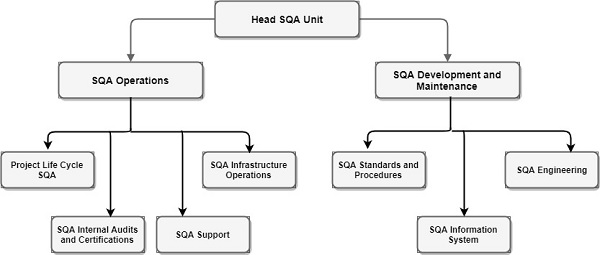
The structure of SQA unit varies by type and size of the organization. The following figure shows an
example of a standard structure and all the components under an SQA unit.
The components of SQA unit are :-
* Head of the SQA Unit
* Project Life Cycle SQA Tasks
* SQA Internal Audit Tasks
* SQA Support Tasks
* SQA Standards and Procedures Tasks
* SQA Engineering Tasks
* SQA Information Systems Tasks
* SQA Trustees and Their Tasks
* SQA Committees and Their Tasks
* SQA Infrastructure Operations Tasks
16. Explain components of SQA unit ?
* Head of the SQA Unit :-
The head of the SQA unit is responsible for all the quality assurance tasks performed by the SQA
unit and its sub-units. These tasks can be classified into the following categories −
(i) Planning tasks
(ii) Management of the unit
(iii) SQA professional activities
* Project Life Cycle SQA Tasks :-
The project life cycle is composed of two stages ,
(i) the development life cycle stage
(ii) the operation maintenance stage.
The development life cycle stage components detect design and programming errors. Its components are
divided into the following sub-classes: Reviews, Expert opinions, and Software testing.
* SQA Infrastructure Operations Tasks :-
SQA systems employ a variety of infrastructure components to operate smoothly, namely −
Procedures and work instructions ,
Supporting quality devices (templates, checklists) ,
Staff training, instruction and certification ,
Preventive and corrective actions ,
Configuration management and
Documentation control .
* SQA Internal Audit and Certification Tasks :-
The types of SQA audits carried out in or by software organizations can be classified in various
terms like Internal audits
, Audits of subcontractors and suppliers to evaluate their SQA systems
, External audits performed by certification bodies
, External audits performed by customers who wish to evaluate the SQA system prior to accepting the
organization as a supplier .
* SQA Support Tasks :-
Most of the consumers of SQA support services are located within the organization. They include
project managers, team leaders and SQA trustees. Their tasks include
Preparation of project plans , project quality plans ,
Staffing review teams ,
Choice of measures to solve identified software development risks ,
Choice of measures to solve schedule delays and budget overruns ,
Choice of SQA metrics and software costs components ,
Choice of development methodologies and tools that reflect the failure experience data accumulated
by the SQA unit .
* SQA Standards and Procedures Tasks :-
The SQA sub-unit is intimately involved in deciding which SQA standards will be adopted as well as
developing and maintaining the organization’s procedures.
* SQA Engineering Tasks :-
SQA engineers, or software quality assurance engineers, evaluate and test software to ensure it
meets the specifications and standards established by the software development company or the
client, and that it's delivered on time.
SQA Engineering Tasks involves Design test plans, scenarios, scripts, procedures .
SQA engineers document software defects using a bug tracking system and report defects to software
developers.
SQA engineers Identify, analyze, and document problems with program function, output, online screen,
or content.
* SQA Information Systems Tasks :-
SQA information systems are meant to facilitate and improve the functioning of SQA systems.
Development of SQA information systems facilitating the SQA unit’s processing of information
delivered by software development and maintenance units including estimates of software quality
metrics and software quality costs
SQA Information Systems tasks include
Development of SQA information systems for software development and maintenance units for collection
of activity data ,
Development and maintenance of the organization’s SQA Internet /Intranet site .
* SQA Trustees and Their Tasks :-
SQA trustees are those members who are primarily involved in the promotion of software quality.
These members provide the internal support necessary for successfully implementing SQA components.
Their tasks may vary depending upon the organizations.
* SQA Committees and Their Tasks :-
SQA committees can be either permanent or ad hoc. The tasks may vary considerably from organization
to organization.
Permanent committees commonly deal with SCC (Software Change Control), CA (Corrective
Actions), procedures, method development tools and quality metrics.
Ad hoc committees commonly deal with specific cases of general interest such as updating a specific
procedure, analysis and solution of a software failure, elaborating software metrics for a targeted
process or product, updating software quality costs and data collection methods for a specific
issue.
17. What is Quality Assurance ?
A planned and systematic pattern of all actions necessary to provide adequate confidence that an
item or product conforms to established technical requirements. A set of activities designed to
evaluate the process by which the products are developed or manufactured.
18. what is the Objectives of SQA ?
Assuring an acceptable level of confidence that the software will conform to functional technical
requirements. Assuring an acceptable level of confidence that the software will conform to
managerial scheduling and budgetary requirements.
19. What is Software Process Assessment ?
Software Process Assessment is a disciplined and organized examination of the software process which
is being used by any organization bases the on the process model. The Software Process Assessment
includes many fields and parts like identification and characterization of current practices, the
ability of current practices to control or avoid significant causes of poor (software) quality,
cost, schedule and identifying areas of strengths and weaknesses of the software.
Types of Software Assessment :-
(i) Self Assessment : This is conducted internally by the people of their own organisation.
(ii) Second Party assessment : This is conducted by an external team or people of the own
organisation are supervised by an external team.
(iii) Third Party assessment : This is performed by an external party or (e.g., a supplier being
assessed by a third party to verify its ability to enter contracts with a customer).
20. What is SCAMPI ?
SCAMPI stands for Standard CMMI Assessment Method for Process Improvement. To fulfil the demands of
the CMMI paradigm, the Standard CMMI Assessment Method for Process Improvement (SCAMPI) was created
(Software Engineering Institute, 2000). Moreover, it is based on the CBA IPI. The CBA IPI and SCAMPI
both have three steps.
(i) Plan and become ready
(ii) Carry out the evaluation on-site
(iii) Report findings