1. What is Software Development Life Cycle (SDLC)?
Software Development Life Cycle (SDLC) is a framework that defines the steps involved in the development of software at each phase. It covers the detailed plan for building, deploying and maintaining the software.
SDLC defines the complete cycle of development i.e. all the tasks involved in planning, creating, testing, and deploying a Software Product.
SDLC is a process that defines the various stages involved in the development of software for delivering a high-quality product. SDLC stages cover the complete life cycle of a software i.e. from inception to retirement of the product.
2. What is the Purpose of SDLC?
Purpose of SDLC is to deliver a high-quality product which is as per the customer’s requirement.
SDLC has defined its phases as, Requirement gathering, Designing, Coding, Testing, and Maintenance. It is important to adhere to the phases to provide the Product in a systematic manner.
For Example, A software has to be developed and a team is divided to work on a feature of the product and is allowed to work as they want. One of the developers decides to design first whereas the other decides to code first and the other on the documentation part.
This will lead to project failure because of which it is necessary to have a good knowledge and understanding among the team members to deliver an expected product.
3. What are the SDLC Phases?
Various SDLC Phases phases are given below:
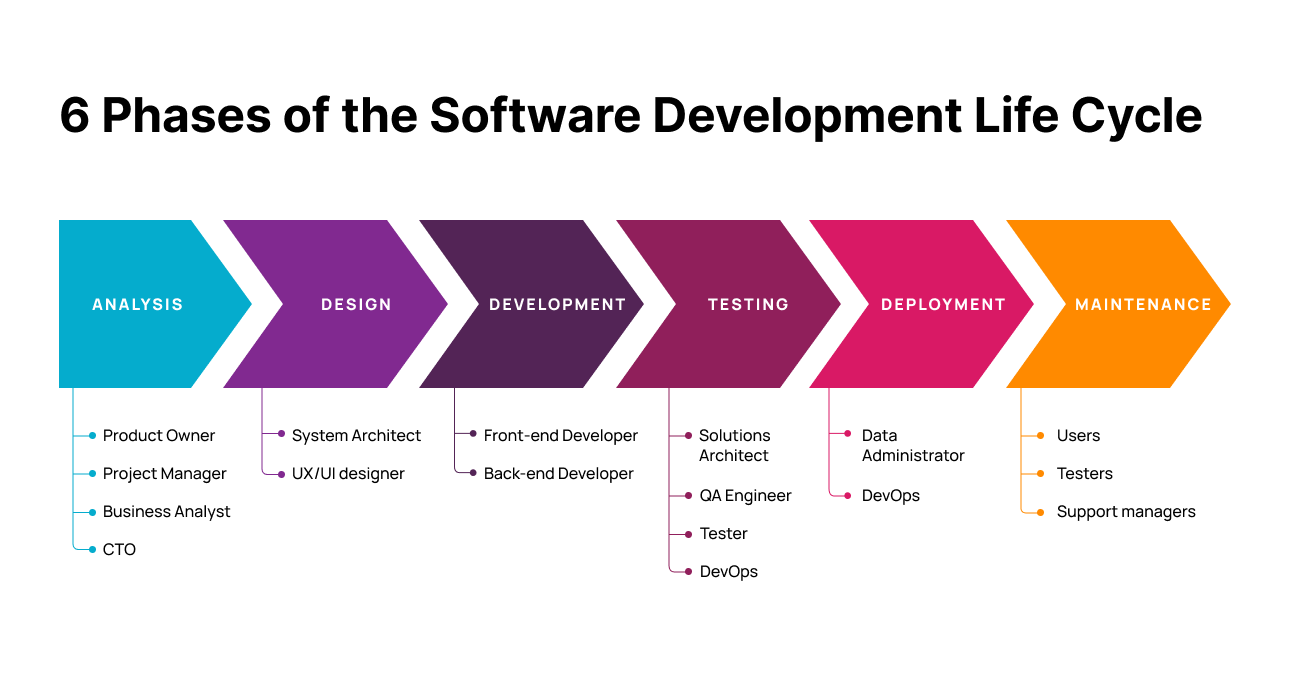
* Requirement gathering and analysis
* Design
* Implementation or coding
* Testing
* Deployment
* Maintenance
4. Explain SDLC Phases ?
* Requirement Gathering and Analysis:
During this phase, all the relevant information is collected from the customer to develop a product as per their expectation.
Project Manager set up a meeting with the customer to gather all the information like what the customer wants to build, who will be the end-user, what is the purpose of the product. Before building a product a core understanding or knowledge of the product is very important.
For Example, A customer wants to have an application which involves money transactions. In this case, the requirement has to be clear like what kind of transactions will be done, how it will be done, in which currency it will be done, etc.
Once the requirement gathering is done, an analysis is done to check the feasibility of the development of a product. In case of any ambiguity, a call is set up for further discussion.
Once the requirement is clearly understood, the SRS (Software Requirement Specification) document is created. This document should be thoroughly understood by the developers and also should be reviewed by the customer for future reference.
*Design:
In this phase, the requirement gathered in the SRS document is used as an input and software architecture that is used for implementing system development is derived.
*Implementation or Coding:
Implementation/Coding starts once the developer gets the Design document. The Software design is translated into source code. All the components of the software are implemented in this phase.
*Testing:
Testing starts once the coding is complete and the modules are released for testing. In this phase, the developed software is tested thoroughly and any defects found are assigned to developers to get them fixed.
Retesting, regression testing is done until the point at which the software is as per the customer’s expectation. Testers refer SRS document to make sure that the software is as per the customer’s standard.
*Deployment:
Once the product is tested, it is deployed in the production environment or first UAT (User Acceptance testing) is done depending on the customer expectation.
In the case of UAT, If the customer finds the application as expected, then sign off is provided by the customer to go live.
*Maintenance:
After the deployment of a product on the production environment, maintenance of the product i.e. if any issue comes up and needs to be fixed or any enhancement is to be done is taken care by the developers.
5. What are the Software Development Life Cycle Models?
A software life cycle model is a descriptive representation of the software development cycle. SDLC models might have a different approach but the basic phases and activity remain the same for all the models.
6. What is Waterfall model?
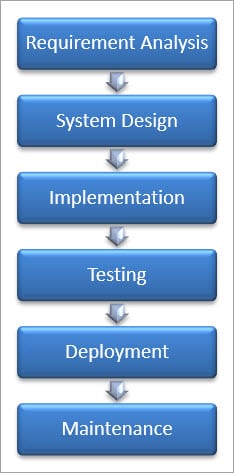
Waterfall model is the very first model that is used in SDLC. It is also known as the linear sequential model.
In this model, the outcome of one phase is the input for the next phase. Development of the next phase starts only when the previous phase is complete.
* Requirement gathering and analysis is done. Once the requirement is freeze then only the System Design can start. Herein, the SRS document created is the output for the Requirement phase and it acts as an input for the System Design.
* In System Design Software architecture and Design, documents which act as an input for the next phase are created i.e. Implementation and coding.
* In the Implementation phase, coding is done and the software developed is the input for the next phase i.e. testing.
* In the testing phase, the developed code is tested thoroughly to detect the defects in the software. Defects are logged into the defect tracking tool and are retested once fixed. Bug logging, Retest, Regression testing goes on until the time the software is in go-live state.
* In the Deployment phase, the developed code is moved into production after the sign off is given by the customer.
* Any issues in the production environment are resolved by the developers which come under maintenance.
7. What is the Advantage of Waterfall Model?
Waterfall model is the simple model which can be easily understood and is the one in which all the phases are done step by step.
Deliverables of each phase are well defined, and this leads to no complexity and makes the project easily manageable.
8. what are the Disadvantages of Waterfall model?
Waterfall model is time-consuming & cannot be used in the short duration projects as in this model a new phase cannot be started until the ongoing phase is completed.
Waterfall model cannot be used for the projects which have uncertain requirement or wherein the requirement keeps on changing as this model expects the requirement to be clear in the requirement gathering and analysis phase itself and any change in the later stages would lead to cost higher as the changes would be required in all the phases.
9. What is Prototype Model?
The prototype model is a model in which the prototype is developed prior to the actual software.
Prototype models have limited functional capabilities and inefficient performance when compared to the actual software. Dummy functions are used to create prototypes. This is a valuable mechanism for understanding the customers’ needs.
Software prototypes are built prior to the actual software to get valuable feedback from the customer. Feedbacks are implemented and the prototype is again reviewed by the customer for any change. This process goes on until the model is accepted by the customer.
Once the requirement gathering is done, the quick design is created and the prototype which is presented to the customer for evaluation is built.
Customer feedback and the refined requirement is used to modify the prototype and is again presented to the customer for evaluation. Once the customer approves the prototype, it is used as a requirement for building the actual software. The actual software is build using the Waterfall model approach.
10. Advantages & Disadvantages of Prototype Model?
Advantages of Prototype Model:
*Prototype model reduces the cost and time of development as the defects are found much earlier.
*Missing feature or functionality or a change in requirement can be identified in the evaluation phase and can be implemented in the refined prototype.
*Involvement of a customer from the initial stage reduces any confusion in the requirement or understanding of any functionality.
Disadvantages of Prototype Model:
*Since the customer is involved in every phase, the customer can change the requirement of the end product which increases the complexity of the scope and may increase the delivery time of the product.
11. What is Spiral Model ?
The Spiral Model includes iterative and prototype approach.
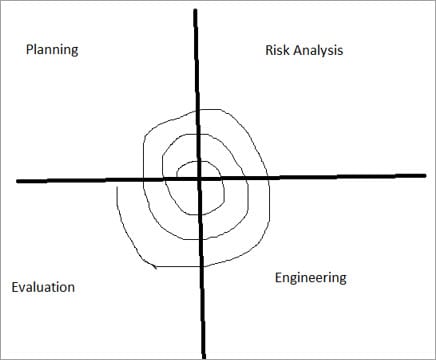
Spiral model phases are followed in the iterations. The loops in the model represent the phase of the SDLC process i.e. the innermost loop is of requirement gathering & analysis which follows the Planning, Risk analysis, development, and evaluation. Next loop is Designing followed by Implementation & then testing.
Spiral Model has four phases:
*Planning
*Risk Analysis
*Engineering
*Evaluation
12. Explain Spiral Model phases?
*Planning:
The planning phase includes requirement gathering wherein all the required information is gathered from the customer and is documented. Software requirement specification document is created for the next phase.
*Risk Analysis:
In this phase, the best solution is selected for the risks involved and analysis is done by building the prototype.
For Example, the risk involved in accessing the data from a remote database can be that the data access rate might be too slow. The risk can be resolved by building a prototype of the data access subsystem.
*Engineering:
Once the risk analysis is done, coding and testing are done.
*Evaluation:
Customer evaluates the developed system and plans for the next iteration.
13. Explain Advantages & Disadvantages of Spiral Model?
Advantages of Spiral Model:
*Risk Analysis is done extensively using the prototype models.
Any enhancement or change in the functionality can be done in the next iteration.
Disadvantages of Spiral Model:
*The spiral model is best suited for large projects only.
The cost can be high as it might take a large number of iterations which can lead to high time to reach the final product.
14. what is Agile Model?
Agile Model is a combination of the Iterative and incremental model. This model focuses more on flexibility while developing a product rather than on the requirement.
In Agile, a product is broken into small incremental builds. It is not developed as a complete product in one go. Each build increments in terms of features. The next build is built on previous functionality.
In agile iterations are termed as sprints. Each sprint lasts for 3-4 weeks. At the end of each sprint, the product owner verifies the product and after his approval, it is delivered to the customer.
Customer feedback is taken for improvement and his suggestions and enhancement are worked on in the next sprint. Testing is done in each sprint to minimize the risk of any failures.
15. What are the Advantages & Disadvantages of Agile Model?
Advantages:
*It allows more flexibility to adapt to the changes.
*The new feature can be added easily.
*Customer satisfaction as the feedback and suggestions are taken at every stage.
Disadvantages:
*Lack of documentation.
*Agile needs experienced and highly skilled resources.
*If a customer is not clear about how exactly they want the product to be, then the project would fail.
16. What is Quality?
Quality is meeting the requirement, expectation, and needs of the customer is free from the defects, lacks and substantial variants. There are standards needs to follow to satisfy the customer requirements.
17. What is Assurance?
Assurance is provided by organization management, it means giving a positive declaration on a product which obtains confidence for the outcome. It gives a security that the product will work without any glitches as per the expectations or requests.
18. what is Quality Assurance?
Quality Assurance is known as QA and focuses on preventing defect. Quality Assurance ensures that the approaches, techniques, methods and processes are designed for the projects are implemented correctly.
Quality assurance activities monitor and verify that the processes used to manage and create the deliverables have been followed and are operative.
Quality Assurance is a proactive process and is Prevention in nature. It recognizes flaws in the process. Quality Assurance has to complete before Quality Control.br>
19. What is Quality Control?
Quality Control is known as QC and focuses on identifying a defect. QC ensures that the approaches, techniques, methods and processes are designed in the project are following correctly. QC activities monitor and verify that the project deliverables meet the defined quality standards.
Quality Control is a reactive process and is detection in nature. It recognizes the defects. Quality Control has to complete after Quality Assurance.
20. What is SRS?
SRS stands for Software Requirement Specification (SRS) document. It is a document to capture all the functional and non-functional requirements of a product. Not all SDLC models need to follow SRS documents, some models capture requirements in the form of user stories, whereas some models in the form of excel sheets, etc.
21. What is the difference between Verification and Validation?
*Verification is the process of ensuring that the product is built right, from a process and standards perspective.
*Validation is the process of ensuring that we build the right product, from a customer perspective. Verification is a static testing methodology wherein the product is tested without executing the code, while validation is a dynamic testing methodology.
22. What are the Functional Requirements?
Functional requirements are the features that a developed software product is expected to perform. For example, adding a payment option at an eCommerce website will be a functional requirement.
23. What are Non-Functional Requirements?
Non-functional requirements measure the usability of the application such as User Interface look and feel, Security, Performance, Interoperability, Reliability, etc.
24. How can you measure Project execution?
Project execution status can be monitored using the following techniques.
*Status Reports
*Milestone checklists
*Activity Monitoring
25. What are CASE tools?
CASE stands for Computer-Aided Software Engineering tools that are utilized to support and accelerate the various activities of the Software Development Lifecycle.
26. What is White box testing?
White box testing is testing the application with the knowledge of the internal structure and code implementation. This testing is generally performed by the developer who has written the code in the form of unit tests.
27. What is Black box testing?
Black box testing involves testing the application without the knowledge of the internal structure or code implementation. Testers would only bother about the functionality of the software in black box testing rather than data flow and code execution in the back end.
28. What is a Feasibility Study?
A feasibility study is conducted on a software product to assess how practical and beneficial is the development of the software product to the organization. Software is analyzed thoroughly to understand the economic and technical aspects of a software product to be developed.
29. Explain the concept of Modularization?
Modularization is used to divide software into multiple components or modules. Each module is worked upon by an independent development and testing team. The final result would be to combine multiple modules into a single working component.
30. What is Software Configuration Management?
Software configuration management is the process of tracking and controlling the changes that occur during the software development lifecycle. Any change made during software development has to be tracked through a well-defined and controlled process.
Configuration management ensures that any changes made during software development are being controlled through a well-defined process.
31. What is Cohesion?
Cohesion is the degree to which the elements of a module are inter-related to one another. It is like an internal glue that binds the elements of a module together. Good software has high levels of cohesion.
32. What is Coupling?
Coupling is the degree of interdependence between the modules. Good software has low levels of coupling.