1. What is AI?
AI, or artificial intelligence, refers to the development of computer systems and machines that can perform tasks that typically require human intelligence. These tasks include learning, reasoning, problem-solving, perception, language understanding, and more. AI aims to create systems that can simulate human intelligence and decision-making processes.
There are various subfields within AI, including:
* Machine Learning:- It involves training algorithms to learn patterns and make predictions based on data, without being explicitly programmed.
* Deep Learning:- A subset of machine learning that uses neural networks with multiple layers to process and analyze large amounts of data, often achieving better accuracy in complex tasks.
* Natural Language Processing (NLP):- Focuses on enabling computers to understand, interpret, and generate human language, facilitating communication between machines and humans.
* Computer Vision:- Involves enabling computers to interpret and analyze visual information from images or videos, mimicking human vision.
* Robotics:- Combines AI with physical machines to create intelligent robots that can interact with the environment and perform tasks autonomously.
* Expert Systems:- Use knowledge and reasoning to simulate human expertise in a specific domain to assist with decision-making.
* Reinforcement Learning:- Involves an agent learning how to make decisions by interacting with an environment and receiving feedback in the form of rewards or penalties.
AI technologies are widely used in various applications, such as virtual assistants (e.g., Siri, Alexa), autonomous vehicles, healthcare (diagnosis, drug discovery), finance (fraud detection, stock market analysis), gaming, recommendation systems, and many more. Ongoing research and advancements in AI continue to expand its potential and applications across different domains.
2. What are the applications of AI?
* Gaming − AI plays crucial role in strategic games such as chess, poker, tic-tac-toe, etc., where machine can think of large number of possible positions based on heuristic knowledge.
* Natural Language Processing − It is possible to interact with the computer that understands natural language spoken by humans.
* Expert Systems − There are some applications which integrate machine, software, and special information to impart reasoning and advising. They provide explanation and advice to the users.
* Vision Systems − These systems understand, interpret, and comprehend visual input on the computer. For example,
* Speech Recognition − Some intelligent systems are capable of hearing and comprehending the language in terms of sentences and their meanings while a human talks to it. It can handle different accents, slang words, noise in the background, change in human’s noise due to cold, etc.
* Intelligent Robots − Robots are able to perform the tasks given by a human. They have sensors to detect physical data from the real world such as light, heat, temperature, movement, sound, bump, and pressure.
3. What is Intelligence in AI?
The ability of a system to calculate, reason, perceive relationships and analogies, learn from experience, store and retrieve information from memory, solve problems, comprehend complex ideas, use natural language fluently, classify, generalize, and adapt new situations.
4. What are the types of Intelligence in AI?
types of Intelligence in AI :
* Linguistic intelligence
* Logical-mathematical intelligence
* Musical intelligence
* Spatial intelligence
* Interpersonal intelligence
* Intra-personal intelligence
* Intra-personal intelligence
5. Explain the types of Intelligence in AI?
* Linguistic intelligence :- The ability to speak, recognize, and use mechanisms of phonology (speech sounds), syntax (grammar), and semantics (meaning).
* Logical-mathematical intelligence :- The ability of use and understand relationships in the absence of action or objects. Understanding complex and abstract ideas.
* Musical intelligence :- The ability to create, communicate with, and understand meanings made of sound, understanding of pitch, rhythm.
* Spatial intelligence :- The ability to perceive visual or spatial information, change it, and re-create visual images without reference to the objects, construct 3D images, and to move and rotate them.
* Interpersonal intelligence :- The ability to recognize and make distinctions among other people’s feelings, beliefs, and intentions.
* Intra-personal intelligence :- The ability to distinguish among one’s own feelings, intentions, and motivations.
6. What are the Intelligence composed of in AI?
* Reasoning
* Learning
* Problem Solving
* Perception
* Linguistic Intelligence
7. What is Reasoning?
It is the set of processes that enables us to provide basis for judgement, making decisions, and prediction.
There are broadly two types −
* Inductive Reasoning :- It conducts specific observations to makes broad general statements. If all of the premises are true in a statement, inductive reasoning allows for the conclusion to be false.
Example − "Sam is a teacher. Sam is studious. Therefore, All teachers are studious."
* Deductive Reasoning :- It starts with a general statement and examines the possibilities to reach a specific, logical conclusion. If something is true of a class of things in general, it is also true for all members of that class. Example − "All men of age above 18 years are adults. John is 25 years. Therefore, John is a adult."
8. What is Perception?
It is the process of acquiring, interpreting, selecting, and organizing sensory information.
Perception presumes sensing. In humans, perception is aided by sensory organs. In the domain of AI, perception mechanism puts the data acquired by the sensors together in a meaningful manner.
9. What is Linguistic Intelligence?
It is one’s ability to use, comprehend, speak, and write the verbal and written language. It is important in interpersonal communication.
10. What is Problem Solving?
It is the process in which one perceives and tries to arrive at a desired solution from a present situation by taking some path, which is blocked by known or unknown hurdles.
Problem solving also includes decision making, which is the process of selecting the best suitable alternative out of multiple alternatives to reach the desired goal are available.
11. What is Learning?
It is the activity of gaining knowledge or skill by studying, practising, being taught, or experiencing something. Learning enhances the awareness of the subjects of the study.
The ability of learning is possessed by humans, some animals, and AI-enabled systems.
Learning is categorized as −
* Auditory Learning − It is learning by listening and hearing. For example, students listening to recorded audio lectures.
* Episodic Learning − To learn by remembering sequences of events that one has witnessed or experienced. This is linear and orderly.
* Motor Learning − It is learning by precise movement of muscles. For example, picking objects, Writing, etc.
* Observational Learning − To learn by watching and imitating others. For example, child tries to learn by mimicking her parent.
* Perceptual Learning − It is learning to recognize stimuli that one has seen before. For example, identifying and classifying objects and situations.
* Relational Learning − It involves learning to differentiate among various stimuli on the basis of relational properties, rather than absolute properties. For Example, Adding ‘little less’ salt at the time of cooking potatoes that came up salty last time, when cooked with adding say a tablespoon of salt.
* Spatial Learning − It is learning through visual stimuli such as images, colors, maps, etc. For Example, A person can create roadmap in mind before actually following the road.
* Response Learning − It is learning to perform a particular behavior when a certain stimulus is present. For example, a dog raises its ear on hearing doorbell.
12. What is Speech Recognition?
The speech recognition aims at understanding and comprehending WHAT was spoken. It is used in hand-free computing, map, or menu navigation. Machine does not need training for Speech Recognition as it is not speaker dependent. Speaker independent Speech Recognition systems are difficult to develop.
13. What is Voice Recognition?
The objective of voice recognition is to recognize WHO is speaking.
It is used to identify a person by analysing its tone, voice pitch, and accent, etc.
This recognition system needs training as it is person oriented.
Speaker dependent Speech Recognition systems are comparatively easy to develop.
14. What are Agents?
An agent is anything that can perceive its environment through sensors and acts upon that environment through effectors.
A human agent has sensory organs such as eyes, ears, nose, tongue and skin parallel to the sensors, and other organs such as hands, legs, mouth, for effectors.
A robotic agent replaces cameras and infrared range finders for the sensors, and various motors and actuators for effectors.
A software agent has encoded bit strings as its programs and actions.
15. What is Rationality?
Rationality is nothing but status of being reasonable, sensible, and having good sense of judgment.
Rationality is concerned with expected actions and results depending upon what the agent has perceived. Performing actions with the aim of obtaining useful information is an important part of rationality.
16. What is ideal rational agent?
An ideal rational agent is the one, which is capable of doing expected actions to maximize its performance measure, on the basis of −
* Its percept sequence
* Its built-in knowledge base
17. What is Simple Reflex Agents?
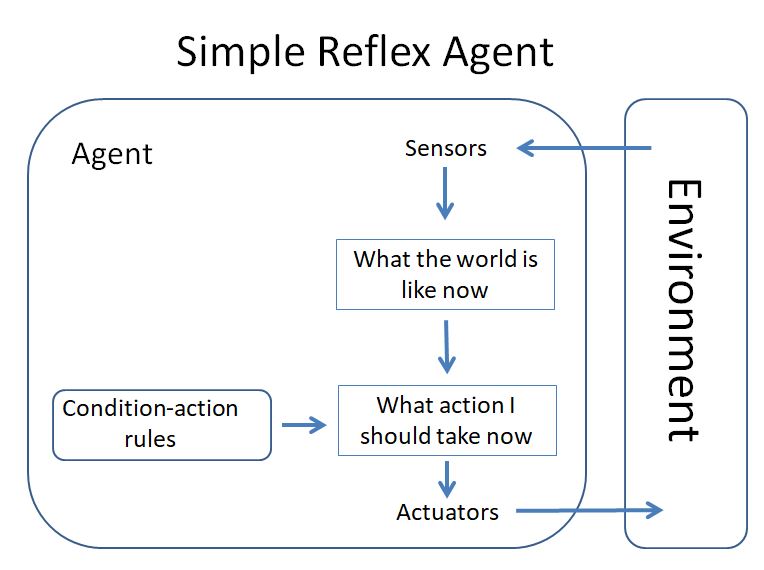
They choose actions only based on the current percept.
They are rational only if a correct decision is made only on the basis of current precept.
Their environment is completely
Condition-Action Rule − It is a rule that maps a state (condition) to an action.
18. What is Voice Model Based Reflex Agents?
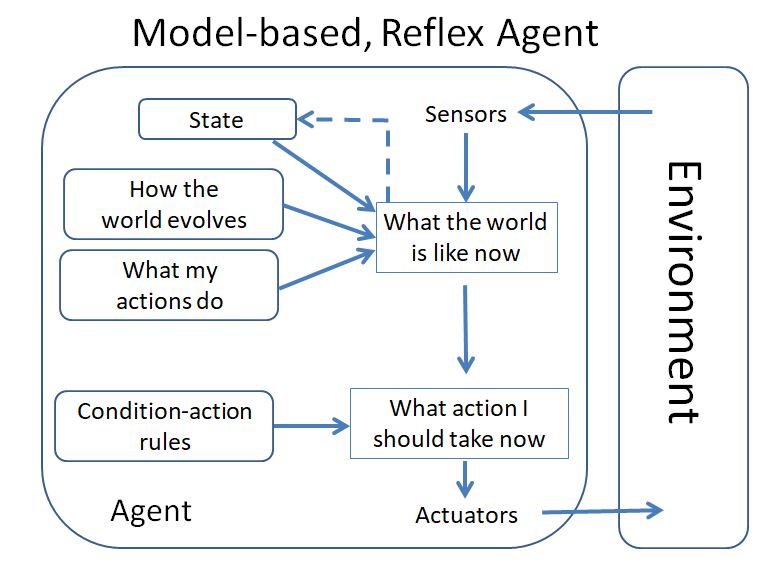
They use a model of the world to choose their actions. They maintain an internal state.
* Model − knowledge about “how the things happen in the world”.
* Internal State − It is a representation of unobserved aspects of current state depending on percept history.
Updating the state requires the information about −
* How the world evolves.
* How the agent’s actions affect the world.
19. What is Goal Based Agents?
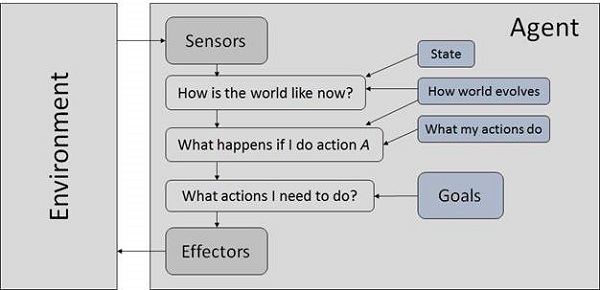
They choose their actions in order to achieve goals. Goal-based approach is more flexible than reflex agent since the knowledge supporting a decision is explicitly modeled, thereby allowing for modifications.
Goal − It is the description of desirable situations.
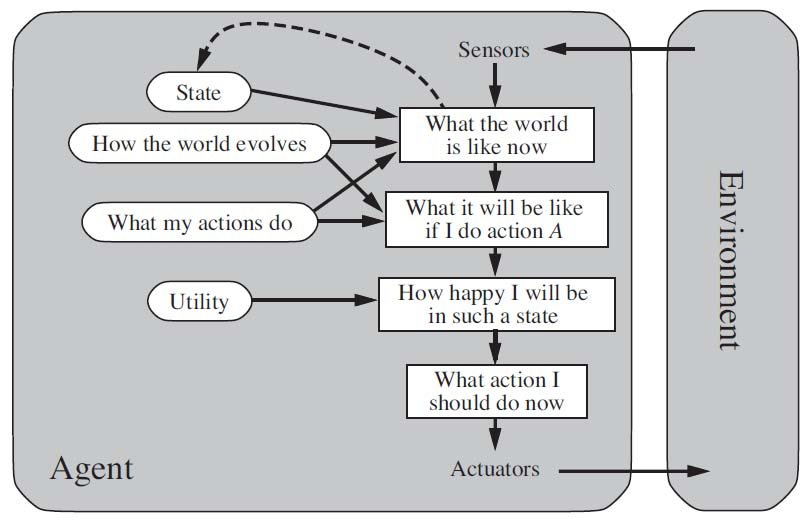
20. What is Utility Based Agents?
They choose actions based on a preference (utility) for each state.
Goals are inadequate when −
There are conflicting goals, out of which only few can be achieved.
Goals have some uncertainty of being achieved and you need to weigh likelihood of success against the importance of a goal.
21. What is Turing Test?
The success of an intelligent behavior of a system can be measured with Turing Test.
Two persons and a machine to be evaluated participate in the test. Out of the two persons, one plays the role of the tester. Each of them sits in different rooms. The tester is unaware of who is machine and who is a human. He interrogates the questions by typing and sending them to both intelligences, to which he receives typed responses.
This test aims at fooling the tester. If the tester fails to determine machine’s response from the human response, then the machine is said to be intelligent.
22. What is Environment in AI?
An environment in artificial intelligence is the surrounding of the agent. The agent takes input from the environment through sensors and delivers the output to the environment through actuators.
23. What are the Properties of Environment?
* Single / Multiple agents − The environment may contain other agents which may be of the same or different kind as that of the agent.
* Static / Dynamic − If the environment does not change while an agent is acting, then it is static; otherwise it is dynamic.
* Accessible / Inaccessible − If the agent’s sensory apparatus can have access to the complete state of the environment, then the environment is accessible to that agent.
* Observable / Partially Observable − If it is possible to determine the complete state of the environment at each time point from the percepts it is observable; otherwise it is only partially observable.
* Deterministic / Non-deterministic − If the next state of the environment is completely determined by the current state and the actions of the agent, then the environment is deterministic; otherwise it is non-deterministic.
* Discrete / Continuous − If there are a limited number of distinct, clearly defined, states of the environment, the environment is discrete (For example, chess); otherwise it is continuous (For example, driving).
* Episodic / Non-episodic − In an episodic environment, each episode consists of the agent perceiving and then acting. The quality of its action depends just on the episode itself. Subsequent episodes do not depend on the actions in the previous episodes. Episodic environments are much simpler because the agent does not need to think ahead.
24. Explain about Search Terminology ?
* Problem Space − It is the environment in which the search takes place.
* Problem Instance − It is Initial state + Goal state.
* Problem Space Graph − It represents problem state. States are shown by nodes and operators are shown by edges.
* Depth of a problem − Length of a shortest path or shortest sequence of operators from Initial State to goal state.
* Space Complexity − The maximum number of nodes that are stored in memory.
* Time Complexity − The maximum number of nodes that are created.
* Admissibility − A property of an algorithm to always find an optimal solution.
* Branching Factor − The average number of child nodes in the problem space graph.
* Depth − Length of the shortest path from initial state to goal state.
25. What is NLP ?
Natural Language Processing (NLP) refers to AI method of communicating with an intelligent systems using a natural language such as English.
Processing of Natural Language is required when you want an intelligent system like robot to perform as per your instructions, when you want to hear decision from a dialogue based clinical expert system, etc.
The field of NLP involves making computers to perform useful tasks with the natural languages humans use. The input and output of an NLP system can be −
Speech &
Written Text
26. Explain Components of NLP ?
There are two components of NLP as given −
* Natural Language Understanding (NLU):-
NLU involves
Mapping of given input in natural language into useful representations and analyzing different aspects of the language.
* Natural Language Generation (NLG):-
It is the process of producing meaningful phrases and sentences in the form of natural language from some internal representation.
It involves Text planning , Sentence planning , Text Realization.
Text planning − It includes retrieving the relevant content from knowledge base.
Sentence planning − It includes choosing required words, forming meaningful phrases, setting tone of the sentence.
Text Realization − It is mapping sentence plan into sentence structure.
27. Explain Steps in NLP ?
There are five steps Steps in NLP −
* Lexical Analysis − It involves identifying and analyzing the structure of words. Lexicon of a language means the collection of words and phrases in a language. Lexical analysis is dividing the whole chunk of txt into paragraphs, sentences, and words.
* Syntactic Analysis (Parsing) − It involves analysis of words in the sentence for grammar and arranging words in a manner that shows the relationship among the words. The sentence such as “The school goes to boy” is rejected by English syntactic analyzer.
* Semantic Analysis − It draws the exact meaning or the dictionary meaning from the text. The text is checked for meaningfulness. It is done by mapping syntactic structures and objects in the task domain. The semantic analyzer disregards sentence such as “hot ice-cream”.
* Discourse Integration − The meaning of any sentence depends upon the meaning of the sentence just before it. In addition, it also brings about the meaning of immediately succeeding sentence.
* Pragmatic Analysis − During this, what was said is re-interpreted on what it actually meant. It involves deriving those aspects of language which require real world knowledge.
28. What are Expert Systems?
The expert systems are the computer applications developed to solve complex problems in a particular domain, at the level of extra-ordinary human intelligence and expertise.
Characteristics of Expert Systems are :-
*High performance
*Understandable
*Reliable
*Highly responsive
Components of Expert Systems are:-
*Knowledge Base
*Inference Engine
*User Interface
29. Explain Knowledge Base ?
The data is collection of facts. The information is organized as data and facts about the task domain. Data, information, and past experience combined together are termed as knowledge.
It contains domain-specific and high-quality knowledge.
Components of Knowledge Base :-
* Factual Knowledge − It is the information widely accepted by the Knowledge Engineers and scholars in the task domain.
* Heuristic Knowledge − It is about practice, accurate judgement, one’s ability of evaluation, and guessing.
30. Explain about Inference Engine ?
Use of efficient procedures and rules by the Inference Engine is essential in deducting a correct, flawless solution.
the Inference Engine acquires and manipulates the knowledge from the knowledge base to arrive at a particular solution.
In case of rule based Expert system, it applies rules repeatedly to the facts, which are obtained from earlier rule application then adds new knowledge into the knowledge base if required.
To recommend a solution, the Inference Engine uses the following strategies −
* Forward Chaining
* Backward Chaining
31. What is Forward Chaining ?
It is a strategy of an expert system to answer the question, “What can happen next?” the Inference Engine follows the chain of conditions and derivations and finally deduces the outcome. It considers all the facts and rules, and sorts them before concluding to a solution. This strategy is followed for working on conclusion, result.
32. What is Backward Chaining ?
By the help of this strategy, an expert system finds out the answer to the question, “Why this happened?” the Inference Engine tries to find out which conditions could have happened in the past for this result. This strategy is followed for finding out cause or reason. For example, "Why error is occuring ?".
33. Explain about Robots & Robotics ?
Robots are the artificial agents acting in real world environment where as Robotics is a domain in artificial intelligence that deals with the study of creating intelligent and efficient robots , which is composed of Electrical Engineering, Mechanical Engineering, and Computer Science for designing, construction, and application of robots.
Robots are aimed at manipulating the objects by perceiving, picking, moving, modifying the physical properties of object, destroying it, or to have an effect thereby freeing manpower from doing repetitive functions without getting bored, distracted, or exhausted.
The robots have mechanical construction, form, or shape designed to accomplish a particular task.
They have electrical components which power and control the machinery.
They contain some level of computer program that determines what, when and how a robot does something.
34. What is Robot Locomotion ?
Locomotion is the mechanism that makes a robot capable of moving in its environment.
There are various types of locomotions :-
* Tracked slip/skid
* Combination of Legged and Wheeled Locomotion
* Wheeled
* Legged
35. Explain Legged Locomotion ?
This type of locomotion consumes more power while demonstrating climb up or down, walk, jump etc.
It requires more number of motors to accomplish a movement. It is suited for rough as well as smooth terrain where irregular or too smooth surface makes it consume more power for a wheeled locomotion. It is little difficult to implement because of stability issues.
It comes with the variety of one, two, four, and six legs. If a robot has multiple legs then leg coordination is necessary for locomotion.
36. What is Wheeled Locomotion ?
It requires fewer number of motors to accomplish a movement. It is little easy to implement as there are less stability issues in case of more number of wheels. It is power efficient as compared to legged locomotion.
* Standard wheel : Rotates around the wheel axle and around the contact
* Castor wheel : Rotates around the wheel axle and the offset steering joint.
* Swedish 45o and Swedish 90o wheels : Omni-wheel, rotates around the contact point, around the wheel axle, and around the rollers.
* Ball or spherical wheel : Omnidirectional wheel, technically difficult to implement.
37. Explain about Slip/Skid Locomotion ?
In Slip/Skid Locomotion, the vehicles use tracks as in a tank. The robot is steered by moving the tracks with different speeds in the same or opposite direction. It offers stability because of large contact area of track and ground
38. What are the various Components of a Robot ?
Various Components of a Robot are :-
* Actuators − They convert energy into movement.
* Power Supply − The robots are powered by batteries, solar power, hydraulic, or pneumatic power sources.
* Muscle Wires − They contract by 5% when electric current is passed through them.
* Electric motors (AC/DC) − They are required for rotational movement.
* Pneumatic Air Muscles − They contract almost 40% when air is sucked in them.
* Piezo Motors and Ultrasonic Motors − Best for industrial robots.
* Sensors − They provide knowledge of real time information on the task environment. Robots are equipped with vision sensors to be to compute the depth in the environment. A tactile sensor imitates the mechanical properties of touch receptors of human fingertips.
39. What is Computer Vision ?
This is a technology of AI with which the robots can see. The computer vision plays vital role in the domains of safety, security, health, access, and entertainment.
Computer vision automatically extracts, analyzes, and comprehends useful information from a single image or an array of images. This process involves development of algorithms to accomplish automatic visual comprehension.
40. What is Artificial Neural Network (ANN) ?
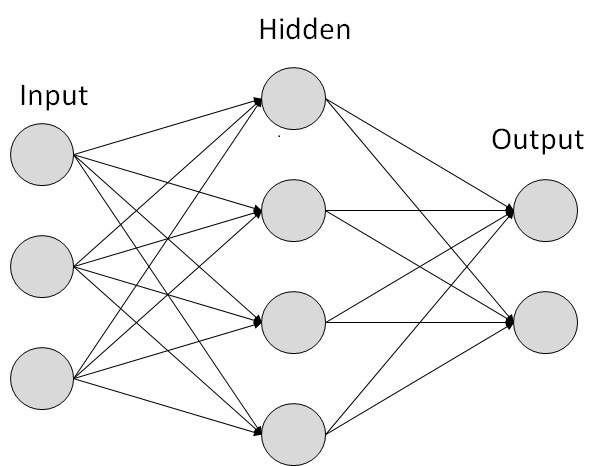
An artificial neural network is a collection of simple interconnected algorithms that process information in response to external input. This neural net is loosely modeled after biological neural networks.
The ANN model is organized in layers, each one made up of interconnected nodes. The input layer communicates with one or more hidden layers. Here, the nodes take the weighted connections and use an activation function to pass their signal to the output layer.
An artificial neural network incorporates a way of learning, of which there are many, that essentially modifies the weights of the connections. In this way, it learns by example.